
Pink Clouds and Gender Panic
What Gender Reveal Parties Actually Reveal

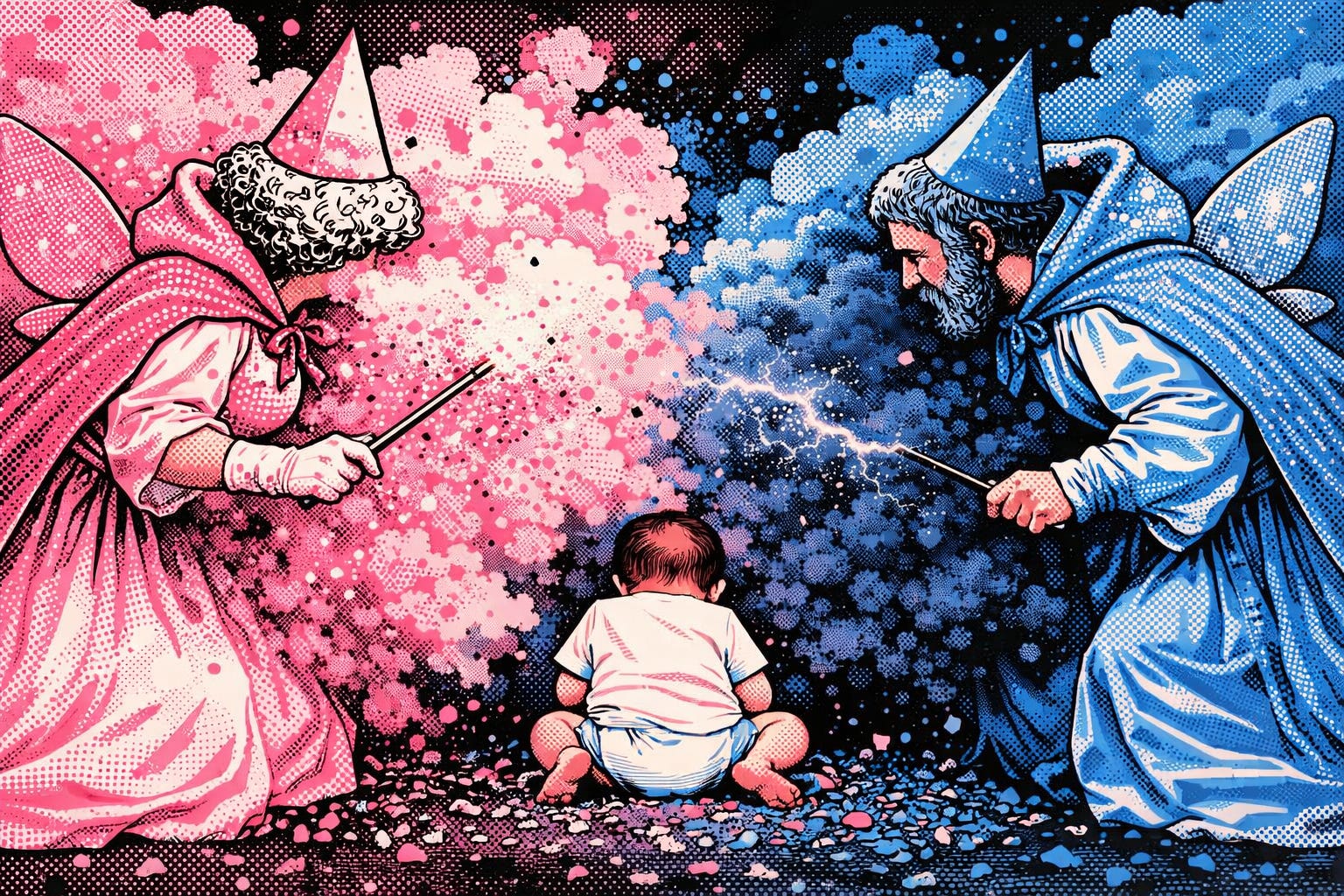
Gender-reveal parties feel recent, unserious, algorithmic. A cake. A balloon. A cloud of pink or blue drifting across a lawn. They invite mockery because they look like excess without depth—too much affect for too little information.
But that misreads the ritual. Gender-reveal parties are not about novelty. They are about timing. They are about when a body becomes a social subject—and what must happen for that transition to feel natural rather than imposed.
At the center of the ritual are two sentences:
It’s a boy.
It’s a girl.
Those sentences do not simply report information. They do something. They confer legibility. They move a fetus from biological fact into social existence. They turn a body that cannot yet be encountered into a person who can be anticipated.
In this sense, the gender-reveal party is not about identity. It is about personhood.
In Judith Butler’s account of performativity, gender is not an inner truth waiting to be expressed, but an iterative act that produces the very subject it claims to describe. Gender works because it is repeated, rehearsed, stabilized over time. What gender-reveal culture exposes is how early that rehearsal now begins. Performativity is staged before the subject can act, speak, or refuse.
The fetus does not become someone because it is alive.
It becomes someone because it has been categorized.
This was not always the case. For most of human history, pregnancy was socially opaque. Before modern medical imaging, the fetus was largely inaccessible to public imagination. What mattered was survival, not individuality. Naming, celebration, and expectation were often delayed. Uncertainty was not a problem to be solved; it was an accepted condition of reproduction.
That order changed dramatically in the mid-twentieth century, not first through law or ethics, but through media.
The most important shift in modern fetal personhood did not occur in a courtroom. It occurred on the page.
In the 1960s, the Time-Life series The Developing Child and related publications circulated high-resolution photographic images of fetuses at different stages of gestation. These images—clean, floating, luminous—were often isolated from the maternal body. The uterus disappeared. Blood, pain, and labor vanished. What remained was the fetus as a discrete, self-contained subject, suspended in space.
This was a profound representational break.
For the first time, large audiences encountered the fetus not as an abstract possibility or a private concern, but as a visible individual with form, posture, and implied intention. The fetus appeared to look, to rest, to drift. It appeared to exist independently.
These images did not merely illustrate development. They restructured perception. They taught viewers how to see the fetus—as a someone rather than a something, as a figure with a future rather than a process in progress.
This is the crucial point: fetal personhood did not emerge because biology changed. It emerged because media made the fetus narratable.
Once the fetus could be seen, it could be imagined. Once it could be imagined, it could be moralized. And once it could be moralized, it could be organized socially.
But visibility alone is unstable. A visible fetus raises too many questions. Who is it? What will it be? How should others relate to it? Media solved this problem by pairing visibility with categorization.
This is where gender enters.
Biological sex, when visually identified, offered a ready-made narrative anchor. It allowed the fetus to be slotted into existing social scripts. Gender supplied pronouns, expectations, aesthetics, and futures. It transformed a visible body into a recognizable subject.
Gender did not follow fetal personhood.
It stabilized it.
Gender-reveal parties are the contemporary ritualization of this logic. They translate medical imaging into public ceremony. They convert anatomical observation into social consensus. They ensure that the fetus is not merely seen, but understood—quickly, collectively, and emotionally.
This is why the reveal must be witnessed. Often, everyone already knows the result. The point is not discovery. The point is confirmation. The speech act must be seen to work. The fetus becomes a person not just because the category is named, but because it is applauded.
This process feels benign because it is celebratory. But celebration can function as a form of enforcement. Joy smooths the transfer of expectation. Confetti disguises the speed with which complexity is resolved.
The pink or blue cloud does not simply announce a future child. It announces that uncertainty has ended. The atmosphere changes. Everyone knows how to feel, how to speak, what to buy, what to imagine.
The relief is palpable—and revealing.
What adults are relieved of is not ignorance, but waiting.
Waiting used to be central to reproduction. Waiting to name. Waiting to imagine. Waiting to attach. Waiting acknowledged that the future was not yet available for management.
Gender-reveal culture collapses that waiting. It installs meaning early, before encounter. It assumes that recognition must precede relationship. The fetus is made socially coherent before it is socially present.
This logic has consequences. When children later resist or reject the gender assigned to them, the footage of the reveal does not simply document a party. It becomes an artifact of expectation. Proof that an identity was prepared in advance, celebrated publicly, archived emotionally.
The child is not only coming out against norms. They are coming out against a recorded future.
Debates about gender-reveal parties often focus on parental intention. Are parents loving? Are they supportive? Those questions miss the structure. This ritual does not require malice to function. It only requires repetition.
What gender-reveal parties reveal is how deeply contemporary culture still relies on gender to decide when a body becomes someone. Fetal personhood demands legibility, and gender supplies it cheaply and efficiently.
Pink clouds feel soft. Confetti feels harmless. But they mark a moment when the future is narrowed prematurely—when a child who has not yet arrived is already being sorted into a story designed to reassure the present.
The panic is not about gender nonconformity.
It is about uncertainty itself.
Gender is how that uncertainty gets resolved early, publicly, and with applause.
The ritual doesn’t create identity.
It creates relief.
And relief, in this case, is the feeling of having decided something before it has had the chance to become strange.