
The Thoughts That Pose While a Stranger Takes Your Photo
The Philosophy of Dead Time #18

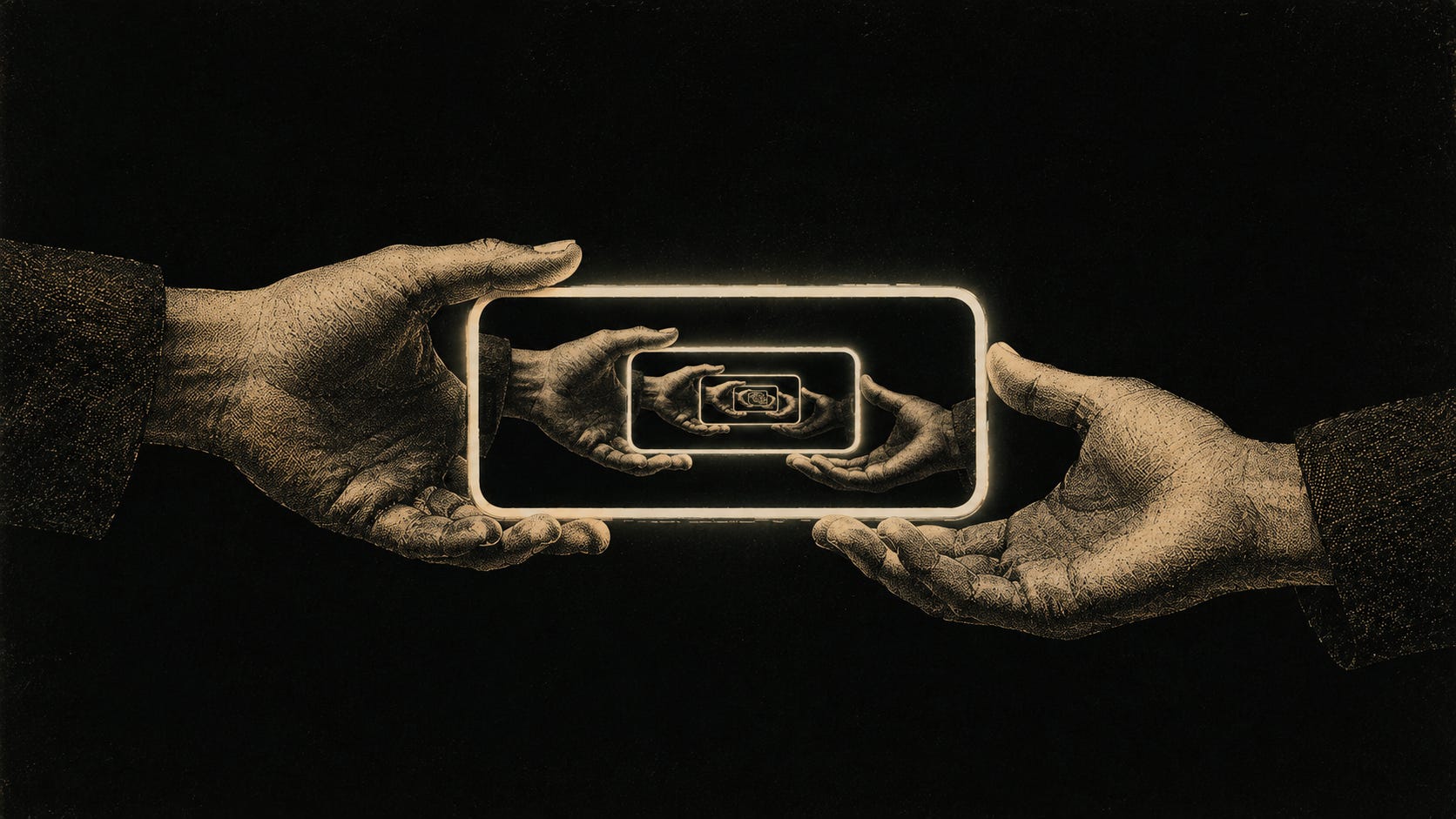
The handoff takes less than a second.
One moment the phone is yours — your angles, your light calculations, your accumulated private knowledge of your own face — and then it isn’t. A stranger’s hands close around it with the careful grip of someone who understands that responsibility has just been transferred.
You smile.
The smile begins dying immediately.
This is not a character flaw. This is neurology. The Duchenne smile — the real one, the involuntary one that reaches the eyes — cannot be summoned on command. The mouth complies. The eyes watch the transaction from a slight distance, like a colleague who showed up to the meeting but isn’t really participating. By four seconds the smile is already structural. By fifteen you are no longer smiling. You are maintaining a position. There is a version of your face happening that is related to happiness the way a cover band is related to music.
The exposure has begun.
You just don’t have a headrest brace.
In the daguerreotype era a portrait required eight minutes of total stillness. A metal brace clamped behind your skull kept you from ruining the exposure. The flash was a magnesium explosion — a small controlled detonation in a room where you were already being asked to hold perfectly still. Nobody smiled in those photographs because smiling for eight minutes is not smiling. It is a medical condition.
You have been standing here for eleven seconds.
The stranger is adjusting something. Waiting for a cloud maybe. Or for the couple behind you to clear the frame. They are being thorough, which is generous and also quietly catastrophic, because thoroughness requires time and time is the enemy of the held smile and your mouth is doing the cover band thing and your brain has opened all fourteen screens simultaneously and none of them are about the photograph anymore.
Screen one: is that the angle? That’s not the angle. That’s the angle that makes you look like you’re being photographed for a missing persons report.
Screen two: you already used the correction. You said could you step back just a little and they stepped back and now the allowance is gone. You can feel the second correction forming in your throat like a small reasonable stone and you are swallowing it because the social contract of asking a stranger to take your photo includes exactly one adjustment and you spent it.
Screen three: there are people waiting. You can feel them. A family of four from somewhere with better manners than you, hovering at the edge of the designated photo spot. The path was designed before you arrived. Even your spontaneity has a designated viewing area. You are taking up the spot and you are the ugly American in this scenario even though you are trying very hard not to be and the trying is probably making it worse.
Screen four: Bazin said the photograph is not a representation of the thing. It is a trace. A mold taken from reality like a death mask, like a fossil. You are standing here producing evidence of presence. The image won’t say you were happy or beautiful. It will say only: this happened. The referent clings to the image like a ghost that cannot leave the house where it died.
Screen five: you are going to post this. Not for the ghost. For the people who will understand that you are someone who goes places. The Bazin trace becomes the ghost becomes the Instagram signal and somewhere in that translation the soul goes somewhere you didn’t intend. Indigenous traditions that held the camera steals the soul were not being superstitious. They were being precise. You can feel the extraction happening right now.
Screen six: you could have taken a selfie. The extended arm still in the frame. The warmth. The naturalness. The photographer visible inside the photograph, which has its own honesty — here is a person who wanted to remember this, here is the arm that wanted it. But the perspective is wrong. You can’t get the landmark and yourself in the same frame at the right scale. The selfie sacrifices ideal perspective for warmth. The stranger sacrifices warmth for ideal perspective. There is no version of this that gives you both. The ideal photograph requires your own disappearance from the frame.
Screen seven: do you have any memory of this place forming right now or is the photograph already replacing it?
Screen eight: your face is doing something your face has never done before. You can feel it. Something structural is happening in the region of your cheekbones that is not smiling and not not-smiling but is a third thing, a held thing, a thing the daguerreotype subjects would recognize. The brace is invisible but your skull knows it’s there.
Screen nine: take the picture.
Screen ten: please.
Screen eleven: you chose this stranger specifically. Out of everyone available you selected this one. You don’t know why. Something about their grip on their own phone. Some rapid unconscious calculus about trustworthiness conducted in under two seconds and then the handoff and now here you are inside a two-minute-and-sixteen-second hostage situation you arranged yourself.
Screen twelve: Barthes wrote about the punctum. The detail in a photograph that wounds you. Not the intended content — the thing that arrives from the image like a needle, uninvited, piercing. You cannot know in advance what it will be. It arrives later, on a Tuesday, and suddenly something small in the background opens a hole in you that nobody intended.
Screen thirteen: you are standing in someone else’s future punctum right now. A stranger’s photograph of this landmark will contain you, small and slightly blurred, in the background, maintaining a position that is related to happiness the way a cover band is related to music. You are their accidental detail. You are already someone else’s wound.
Screen fourteen: who is this even for?
The phone comes back.
You say thank you so much and you mean it and you do not look at the photo while the stranger is still there because checking the photo in front of them is returning the meal to the kitchen while the chef watches and the social contract has rules and you have already spent your one adjustment.
They say no problem and they mean that too and they will not remember your face by tomorrow and they walk back into their own life which contains no chapter about you whatsoever.
You wait until they round the corner.
You look.
The angle is slightly wrong. Not their fault. Just wrong. Not the picture you had in your head on the walk over.
You raise the phone.
You take the selfie.
It takes four seconds. You get it on the second try because you know the angle.
You knew it the whole time.
The ghost finds the house it was looking for.
Somewhere a family of four from somewhere with better manners steps into the designated spot.
The exposure ends.
You were there.