
On Wednesdays We Wear Black
On the Changing Face of America's Favorite Goth Girl

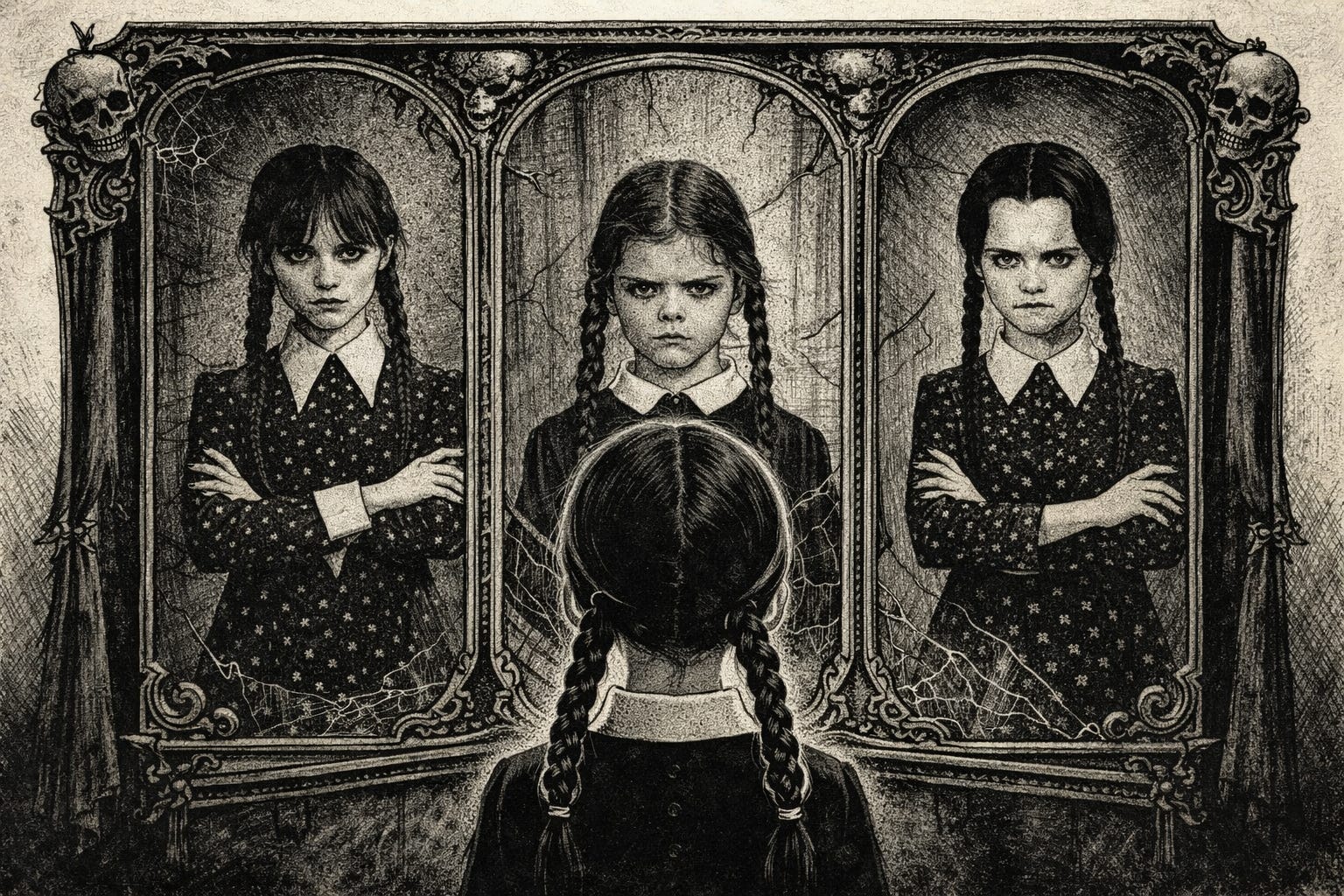
Wednesday’s child is full of woe. The line is usually read as temperament—gloom, morbidity, a fondness for darkness. But taken literally, it sounds less like a personality trait than a verdict. Not on the child, but on the world that keeps trying to tell her who she is supposed to be.
The Addams Family has always known something crucial about American normalcy: it depends on being watched from a safe distance. Difference is not merely tolerated; it is curated, staged, and interpreted. Long before inclusion became an administrative value, freak shows did this work openly. They arranged bodies, behaviors, and lives into exhibitions designed to reassure the spectator of their own coherence.
The Addamses never asked to be removed from that system. They repossessed it.
From its earliest television incarnation, The Addams Family treated domestic space as an exhibition hall. “Their house is a museum where people come to see ’em” is not just a theme-song joke. It is a structural claim. Outsiders enter believing they are spectators. They leave having lost control of the gaze.
The recurring setup is simple. A representative of normalcy—a truancy officer, a neighbor, a civic authority—arrives armed with confidence. The camera often aligns us with them at first. We see the curios, the excess, the objects that refuse explanation. Then the alignment breaks. The visitor panics. The visitor becomes loud, clumsy, hysterical. The Addamses respond not with aggression, but with mild curiosity. “Weird, isn’t he?” Gomez remarks, watching an official flee.
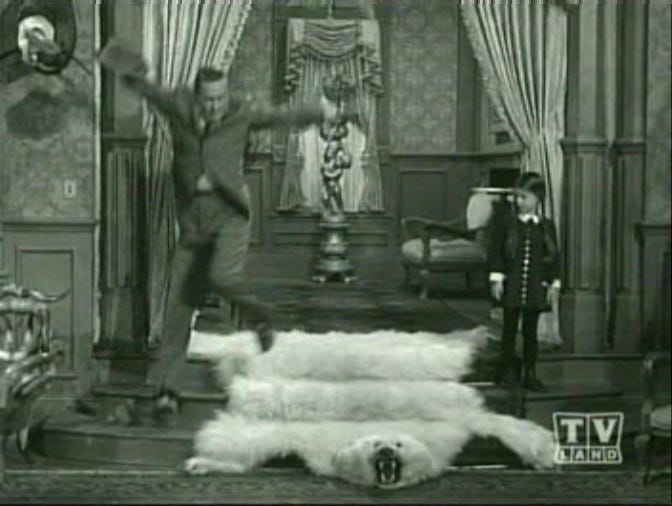
The joke lands because freakishness has been reassigned. The spectacle is no longer the body on display. It is the subject who cannot withstand being seen back.
This is freak-show logic inverted and domesticated. Historically, the freak show stabilized the spectator’s identity through distance. The abnormal body was hypervisible so the viewer could feel safely bounded, neutral, unmarked. The Addams Family collapses that distance. Freakery is not an event or a carnival. It is a way of life. Entering the house is not a visit; it is a risk. There is no exit that leaves you unchanged.
That structure remains stable across decades, but its tone sharpens. In the 1990s films, the Addamses acquire something new: confidence about authorship itself. Under the pen of openly gay writer Paul Rudnick, the family stops merely inverting the gaze and begins judging it.
Rudnick’s Addams films do not explain camp. They assume it. They do not ask whether normativity is cruel; they show it to be small-minded, extractive, and historically forgetful. Suburban cheer curdles into discipline. Assimilation becomes a demand to disappear politely.
The Addamses do not want entry into the mainstream. They want autonomy from it. The joke is no longer that they are strange. The joke is that normality keeps mistaking itself for neutrality.
Nowhere is this clearer than in Addams Family Values, in the Thanksgiving pageant scene that has been endlessly quoted and rarely taken seriously enough. On the surface, the moment plays as camp revenge fantasy: Wednesday Addams, cast as a pilgrim, hijacks the narrative and turns it into a blistering indictment of American origin mythology.
But the scene is not merely about hypocrisy. It is about spectacle. The pageant demands gratitude, innocence, and closure. Genocide is rewritten as cheerful prelude. Violence is aestheticized into ritual. History is performed so it can be forgotten safely.
Wednesday’s intervention is not corrective. She does not ask for a better role. She refuses the premise of the performance itself. She seizes the stage long enough to expose the lie, then burns the set down.
This is where Wednesday becomes more than a precocious goth child. She becomes a carrier of memory that the spectacle requires its participants to surrender. Her woe is not sadness. It is knowledge.
That knowledge exposes the founding logic of the republic itself. The United States has always depended on pageantry to launder violence into destiny. Pilgrims, pioneers, manifest futures—these are not neutral stories. They are performances designed to stabilize the spectator and discipline the child.
Woe for the republic, then, is not a curse. It is a diagnosis.
The Netflix series Wednesday makes this diagnosis legible by placing Wednesday inside an institution that believes it has learned from history. Nevermore Academy does not exclude difference. It curates it. It categorizes outcasts, aestheticizes their abilities, and translates trauma into administrable narratives of growth.
Wednesday’s problem is not marginalization. It is capture.
She is welcomed, spotlighted, encouraged to tell her story. She refuses. She withholds interiority. She resists therapeutic confession. She declines the demand to make herself legible for institutional comfort.
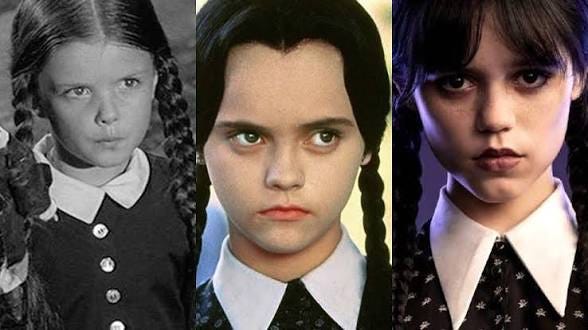
This is the crucial evolution. The freak show has not disappeared. It has gone liberal. It now calls itself inclusion.
Where the original Addams Family inverted the gaze, and the 1990s films mocked it, Wednesday’s refusal is quieter and more dangerous. She does not argue. She does not correct. She withholds.
Her refusal is not antisocial. It is anti-extractive. She understands that visibility is never free. Someone always profits from it.
Season one’s villain—a resurrected Puritan zealot bent on eradicating difference—functions less as plot device than as reminder. Beneath liberal tolerance, the older violence waits. Institutions may soften their language, but the desire to discipline, categorize, and erase never fully leaves.
Wednesday does not defeat this violence by persuasion or reform. She defeats it by interrupting lineage. She refuses to let the story complete itself.
Seen across its iterations, the Addams lineage traces a quiet but devastating arc in queer cultural strategy. The 1960s taught us how to survive being looked at. The 1990s taught us how to laugh back. The present asks a harder question: what happens when refusal becomes the only ethical option left?
Wednesday’s child is full of woe because she knows too much to perform innocence. Her refusal is not a tantrum. It is a verdict.
Woe for the republic, not because it is being criticized, but because it keeps demanding gratitude from those it insists on treating as exhibits.
The Addamses never wanted to be normal. What they wanted—and what Wednesday finally claims outright—is control over the conditions of appearance. The right to decide when to be seen, and when to walk out of the museum without explaining the exhibit.
Brilliant
This was so well done that I immediately became a paid subscriber, which is genuinely high praise coming from a near-lifelong and deeply devoted Chas Addams fan.
You absolutely nailed your analysis of Wednesday. The second a friend sent me this article, I stopped what I was doing and dove right in. From the original series to the Tim Burton adaptation, your observations felt thoughtful, precise, and incredibly well understood.
I’m usually pretty critical of op-eds about this franchise because so many miss the heart of what makes it work, but this was exceptional. Truly a 100/10. Not a single note.